Machine Learning in Concussion Prediction
ML uses cognitive tests, wearables, and symptoms to predict concussion recovery and future musculoskeletal injury risk while noting data and ethical limits.
Machine learning is reshaping how concussions are predicted and managed in sports. By analyzing large datasets, these models identify patterns that traditional methods often miss, offering insights into recovery timelines and injury risks. Here's what you need to know:
- Concussions are complex injuries that affect brain function and are common in contact sports like football, soccer, and hockey.
- Traditional methods (like symptom checklists) can be subjective and miss subtle deficits.
- Machine learning models analyze variables like cognitive scores, injury history, and biomechanical data to create personalized risk profiles.
- Studies show ML can predict:
- Recovery timelines: 89% accuracy in distinguishing between typical (≤28 days) and prolonged recovery (>28 days).
- Secondary injury risks: 95% accuracy in identifying athletes at risk for musculoskeletal injuries post-concussion.
These tools rely on quality data, including cognitive tests, wearable sensors, and symptom tracking, to provide actionable insights. While promising, challenges like data consistency, ethical concerns, and integration with existing systems remain. However, ML is proving to be a powerful ally in improving concussion care and athlete safety.
A Hybrid Method to Predict Sports Related Concussions with Machine Learning, Melody Yin
Recent Research on Machine Learning for Concussion Prediction
In recent years, researchers have been diving deep into how machine learning (ML) can reshape concussion management. These studies aim to create tools that enhance athlete safety and recovery, building on earlier knowledge to integrate predictive analytics into concussion care.
ML Models for Predicting Recovery Timelines
After a concussion, one of the biggest questions is: When can the athlete safely return to play? Traditional methods often rely on symptom tracking and clinical judgment, which can vary widely. Machine learning is stepping in to provide a more data-focused approach.
In July 2025, Garrett A. Thomas and Peter A. Arnett published a proof-of-concept study in the Archives of Clinical Neuropsychology, addressing this very issue. Their research analyzed data from 971 college athletes using two major databases: the Federal Interagency Traumatic Brain Injury Research Informatics System (FITBIR) and the Concussion Assessment, Research and Education (CARE) Consortium.
They used random forest models to predict whether an athlete would recover within the typical timeframe (28 days or less) or experience a prolonged recovery (more than 28 days). The model achieved an 89.04% testing accuracy (F1: 0.56) and an 85.52% validation accuracy (F1: 0.40), with an AUC of 0.85. The key advantage? These predictions are based on data collected 24–48 hours after injury, allowing medical teams to act early and set realistic recovery expectations for athletes and coaches.
The study identified 31 critical features, mostly related to post-concussion symptoms and cognitive performance, as the driving factors behind these predictions. This aligns with what clinicians have long suspected - early symptom patterns often provide valuable clues about recovery.
However, when the researchers attempted to predict the exact number of recovery days using a regression model, the results were less precise. The random forest regression model explained only 21% of the variance in testing sets and 17% in validation sets. While ML is effective at categorizing recovery into broad timeframes, predicting exact dates remains a challenge due to individual factors that are harder to quantify.
Identifying Secondary Injury Risks After Concussion
Machine learning isn’t just about predicting recovery timelines - it’s also uncovering risks that extend beyond initial symptom resolution. One significant finding is the heightened risk of secondary musculoskeletal injuries after a concussion, which can persist even after athletes feel ready to return to play.
In April 2025, the University of Delaware's Concussion Research Lab, led by Professor Thomas Buckley, introduced an AI model designed to address this issue. The model analyzed over 100 variables, including sports and medical histories, concussion type, and pre- and post-concussion cognitive data, achieving an impressive 95% accuracy in predicting lower-extremity musculoskeletal injury risk.
Tracking athletes over a two-year period, the study revealed a surprising pattern: the risk of musculoskeletal injuries increases over time, rather than peaking immediately after returning to play. This suggests that athletes may unknowingly compensate for subtle deficits, raising their injury risk.
Interestingly, the model focused on individual characteristics rather than sport-specific factors. It accurately predicted injury risk even without sport-specific data, challenging the assumption that certain sports are inherently more dangerous post-concussion. Instead, factors like baseline cognitive function, balance, and individual response patterns proved more predictive.
Dan Watson, UD Athletics' deputy athletic director of competitive excellence, highlighted the practical benefits of this approach:
The AI model helps target high-risk athletes and incorporate strategies to reduce injury risk, with the goal of both improving athlete abilities and keeping them on the field.
Beyond sports, this research could have broader applications. The team believes the model could be adapted to predict fall risks in patients with Parkinson’s disease or even explore whether lifestyle factors - like weight, BMI, and smoking history - might predict future cognitive decline or Alzheimer’s disease.
Meanwhile, researchers at the National Intrepid Center of Excellence (NICoE) have been applying ML to predict recovery outcomes in military service members with traumatic brain injuries. Using XGBoost models, they analyzed data from a four-week outpatient program. Their model achieved 79% AUC with 72% accuracy, incorporating demographics and symptom cluster measures.
The NICoE study identified the top five predictive features: posttraumatic stress arousal, avoidance, and reexperiencing sub-scores, education level, and postconcussive symptoms cognitive sub-score. Notably, the severity of posttraumatic stress symptoms upon admission emerged as the strongest predictor of significant clinical improvement. This highlights the critical role psychological factors play in recovery and the importance of incorporating them into ML models.
Together, these studies demonstrate how machine learning is reshaping concussion care. From predicting recovery timelines to identifying secondary risks, ML is uncovering patterns and connections that traditional clinical methods might miss. These insights are paving the way for more personalized and effective approaches to managing brain injuries.
Machine Learning Applications in Concussion Care
Research into concussion prediction is part of a broader transformation in how traumatic brain injuries (TBI) are managed. While these machine learning (ML) tools have gained attention in sports medicine, their impact extends far beyond the playing field. They're reshaping how clinicians and rehabilitation specialists approach brain injury recovery for everyone - from military personnel to everyday patients. The same ML techniques being honed for athletes are proving equally useful in medical settings far removed from sports.
TBI Recovery Prediction Using ML
At the National Intrepid Center of Excellence (NICoE), researchers are using ML to predict which TBI patients are most likely to benefit from intensive rehabilitation programs. The focus is on a four-week interdisciplinary Intensive Outpatient Program designed specifically for U.S. service members recovering from TBIs.
By applying extreme gradient boosting (XGBoost) models, the NICoE team analyzed patient data to predict who would experience significant clinical improvement. Their initial model, which used basic demographic information and total self-reported scores, achieved 75% AUC with 68% accuracy. When they incorporated detailed symptom clusters, the model's performance improved to 79% AUC with 72% accuracy.
The analysis highlighted five key factors: posttraumatic stress arousal, avoidance, reexperiencing sub-scores, education level, and cognitive symptoms related to postconcussion experiences. One major takeaway was the critical role psychological factors play in TBI recovery - sometimes even outweighing the physical injury itself.
Among these factors, the severity of posttraumatic stress symptoms at the start of the program stood out as the strongest predictor of recovery success. This insight underscores the importance of addressing mental health issues early and aggressively to improve rehabilitation outcomes.
This precision-focused approach allows healthcare providers to allocate resources more effectively. By predicting which patients are likely to respond well to treatment, resources can be directed toward those who need them most. The same principles apply to athletes recovering from concussions, where understanding the connections between physical symptoms, cognitive challenges, and psychological factors leads to more tailored recovery plans.
Interestingly, the relationship between sports concussion research and broader TBI care is reciprocal. Military TBI programs benefit from the detailed data collection methods developed in collegiate sports, while athletic programs learn from the interdisciplinary treatment strategies used in clinical settings. Both emphasize the importance of early assessment, particularly within the first 24–48 hours after injury, to better predict recovery paths .
These advancements are paving the way for integrating new data sources that enhance concussion analytics.
New Data Sources for Concussion Analytics
The effectiveness of ML models depends heavily on the quality and diversity of the data they analyze. Traditional concussion assessments relied on symptom checklists and basic cognitive tests conducted in clinical settings. Modern ML-powered concussion tools, however, draw from a much broader array of data, providing a more comprehensive view of brain function post-injury.
Wearable sensors and instrumented equipment are playing a key role in this evolution. These devices now capture objective biomechanical data - such as impact forces and balance metrics - that complement traditional cognitive assessments. They can reveal subtle issues with balance, reaction times, and movement patterns that might go unnoticed during standard clinical exams.
The scope of these ML methodologies is expanding across various settings, with rich datasets enabling more accurate predictions. For example, AI models analyzing over 100 variables per athlete - including medical histories, concussion types, cognitive data, and biomechanical measurements - achieved 95% accuracy in predicting post-concussion musculoskeletal injury risks. This level of precision was unimaginable with older assessment methods.
Mobile neurocognitive testing has also simplified data collection, allowing for frequent assessments in natural environments. Athletes no longer need to visit labs for testing; instead, they can use smartphones or tablets for regular evaluations. This approach generates longitudinal data streams, tracking how cognitive functions evolve over time rather than relying on isolated snapshots. Such multi-modal data integration reinforces the movement toward individualized concussion management.
The real breakthrough lies not in collecting more data but in gathering the right kinds of data at the right times. ML models excel when they track an athlete's performance over time, comparing current metrics to personal baselines rather than generic benchmarks. This personalized approach is crucial because concussions impact balance, cognition, and reaction times differently for each individual. Even tiny variations in these areas can influence injury risks.
For example, force plates can measure how athletes distribute weight and maintain balance, identifying muscle imbalances or movement compensations that increase the likelihood of injury. When combined with symptom reports and cognitive test results, this biomechanical data provides a fuller picture of recovery progress.
The trend toward multi-modal data fusion - integrating clinical assessments, self-reports, cognitive tests, biomechanical data, and even neuroimaging - reflects a shift toward precision-based care in both sports and TBI recovery. No single data source can capture the entire picture, but ML algorithms can detect patterns across multiple streams, identifying subtle warning signs that individual tests might miss.
For athletic programs and healthcare providers looking to adopt ML-driven concussion care, the takeaway is clear: invest in robust data collection systems. Standardized symptom scales and neurocognitive tests conducted within 24–48 hours of injury lay the groundwork. Adding biomechanical evaluations, mental health screenings, and ongoing tracking creates the comprehensive datasets needed for accurate, actionable insights. Platforms that already consolidate real-time performance data across leagues can also integrate concussion analytics, connecting injury data with broader performance monitoring systems.
Practical Uses and Limitations of ML in Concussion Prediction
Machine learning (ML) has opened new doors in concussion care, offering exciting possibilities for sports medicine. However, its practical use in professional and collegiate sports requires careful navigation, balancing its technological promise with real-world clinical, ethical, and operational challenges.
Impact on Player Safety and Team Strategy
Recent studies demonstrate how ML can improve concussion prediction and help teams adopt proactive strategies. These tools are shifting the focus from reactive injury management to preventing risks before they escalate. A notable application is in return-to-play (RTP) decisions, where ML provides data-driven insights that complement the expertise of medical professionals.
For example, the University of Delaware (UD) developed an ML model in April 2025 that predicts lower-extremity injury risks with 95% accuracy. Over two years, researchers analyzed more than 100 variables to identify athletes at higher risk for injuries like ACL tears and sprains after returning to play. Interestingly, the model revealed that injury risk increases gradually during the RTP period, rather than being limited to the immediate post-clearance phase. This insight has led UD Athletics to combine the model with their force plate and conditioning systems, enabling targeted interventions such as balance training and neuromuscular re-education for high-risk athletes.
Professional leagues, including the NFL, NBA, and MLB, are also exploring ML to enhance player safety and team management. ML predictions can guide adjustments in player workloads and practice intensity for those flagged as high-risk. By integrating ML insights with platforms like StatPro, which consolidates injury records, performance data, and analytics, teams can create comprehensive health management systems. This approach not only helps optimize player performance but also reduces the likelihood of severe injuries.
Challenges and Limitations
While the UD model boasts high accuracy in secondary injury prediction, not all ML tools perform as well. For example, a random forest regression model using data from 971 college athletes predicted RTP timelines but explained only about 20% of the variation in recovery duration. Such tools can flag potential concerns but fall short of making definitive decisions without clinical input.
Data quality and consistency are critical hurdles. ML models rely on standardized inputs, such as symptom scales, cognitive tests, and balance assessments, ideally gathered within 24–48 hours post-injury. Variations in data collection practices can limit the model's reliability across different athlete groups.
Privacy and ethical concerns also loom large. Predictive risk scores can potentially be misused, affecting contract negotiations or leading to premature roster changes, even if a player ultimately recovers well. To address this, teams and leagues must enforce strict data governance policies and involve ethical review boards in ML deployment. Transparency about how predictions influence decisions is equally important to protect player interests.
Another challenge is the risk of over-relying on algorithms. ML tools are designed to assist - not replace - clinical judgment. They may overlook subtle, nuanced signs that only experienced medical professionals can detect. To ensure balanced use, staff must be trained to interpret ML outputs and override them when necessary. Regular audits of the model's real-world performance are also crucial.
Validation across diverse settings is another obstacle. A model that works well in controlled research environments must prove its effectiveness across different sports, levels of play, and populations. It also needs to show tangible benefits, such as reduced reinjury rates or improved long-term health outcomes. Achieving this requires resource-intensive validation studies in varied athletic populations.
Lastly, technical integration poses practical challenges. ML tools must seamlessly connect with existing medical record systems, performance tracking platforms, and clinical workflows without adding extra burdens on medical staff. The success seen at the University of Delaware highlights the importance of institutional commitment and collaboration among researchers, athletic trainers, and conditioning coaches.
Comparison of ML Approaches
The following table highlights how different ML models compare in addressing concussion-related challenges:
| ML Model / Study | Features | Outcome Predicted | Performance Metrics | Source |
|---|---|---|---|---|
| UD AI Model (Buckley et al.) | >100 variables: sports/medical history, concussion type, pre/post-cognitive data, balance, reaction time | Risk of lower-extremity musculoskeletal injury after concussion | 95% accuracy | |
| Random Forest Regression (Thomas et al.) | 31 features: post-concussion symptoms, cognitive performance (24–48 hr post), individual factors, injury data | Days to return-to-play after sports-related concussion | R² = 21% (test), 17% (validation) | |
| XGBoost Model (NICoE TBI IOP) | Demographics, total self-report scores (PTSD, depression, anxiety, post-concussion symptoms, sleep) | Clinically significant improvement in PTSD and post-concussion symptoms | Accuracy 68%, AUC 75% | |
| XGBoost Model with Symptom Clusters (NICoE TBI IOP) | Demographics, total scores, and symptom cluster scores (e.g., PTSD arousal, avoidance, reexperiencing; cognitive sub-score) | Clinically significant improvement in PTSD and post-concussion symptoms | Accuracy 72%, AUC 79% |
The University of Delaware model stands out for its focus on predicting musculoskeletal injuries rather than recovery timelines or symptom resolution. In contrast, the random forest regression model emphasizes connections between early symptom patterns and RTP timelines. Meanwhile, the XGBoost models from the National Intrepid Center of Excellence show how detailed symptom clustering can improve predictions for PTSD and post-concussion outcomes.
This comparison highlights the varying strengths and weaknesses of ML approaches, emphasizing the importance of tailoring tools to specific clinical or operational goals.
Future Directions in ML for Concussion Prediction
Machine learning (ML) for concussion prediction is rapidly evolving, with new systems combining diverse data sources to provide continuous monitoring and actionable insights for medical teams.
Combining Multiple Data Types for Better Predictions
Future ML systems are poised to integrate a variety of data types for more accurate and personalized predictions. Wearable sensors and force plates are already making strides in this area, offering continuous biomechanical data that can detect subtle movement issues invisible to the human eye. For example, the University of Delaware Athletics employs force plates to assess movement patterns and identify muscle imbalances in real time, feeding this data into their ML models. When paired with baseline measurements, these tools can flag deviations in balance or reaction time specific to an athlete’s personal norms - providing a more reliable indicator than population averages.
Cognitive and symptom tracking will also play a bigger role. Mobile apps designed for daily symptom reporting could create a more comprehensive picture of an athlete’s recovery over time, rather than relying on one-off assessments.
Psychological data is emerging as another critical factor. A 2025 study on traumatic brain injury showed that including symptom clusters - such as PTSD-related arousal, avoidance, and reexperiencing - improved model accuracy from 75% to 79% AUC. This highlights the importance of incorporating mental health metrics, sleep quality, and stress levels into next-generation concussion models.
Additionally, game statistics and workload data are proving useful in identifying undetected deficits. Platforms that track play counts, practice intensity, and performance metrics can help flag when athletes are compensating for subtle impairments. Interestingly, the Delaware model revealed that individual characteristics are often just as predictive as sport type. Even when sport-specific information was removed, the AI accurately predicted post-concussion musculoskeletal injury risk. This underscores the importance of personalized data - how an athlete deviates from their own baseline - over general patterns.
The timing of injuries also matters. Research shows that the risk of secondary injuries doesn’t peak immediately after returning to play but can increase over time as athletes unknowingly compensate for deficits. Future systems will need to monitor athletes throughout entire seasons, not just during the immediate recovery period.
With all this data fusion, transparency in AI predictions becomes crucial for clinical trust and adoption.
Explainable AI for Concussion Analytics
Even the most accurate ML models must provide clear, interpretable outputs to gain acceptance in clinical settings. This is where Explainable AI (XAI) comes into play.
Current research already uses feature importance analysis to highlight the variables driving predictions. For instance, an XGBoost model for traumatic brain injury treatment identified posttraumatic stress symptom severity, education level, and cognitive symptoms as key predictors. This level of transparency helps clinicians understand the logic behind risk scores, making it easier to design targeted interventions.
SHAP values take this a step further by offering precise, individualized risk attributions. These values clarify how much each factor - like balance deficits or symptom severity - contributes to a prediction. For example, if the model identifies balance issues as a primary risk factor, strength and conditioning staff can tailor exercises to address that specific weakness.
Explainable models also ensure that algorithms rely on clinically relevant variables rather than spurious correlations. This accountability is critical in medicine, where professionals need to validate that predictions align with their expertise. When a model flags an athlete as high-risk, clinicians should be able to review the contributing factors - such as reaction time decline, symptom severity, or concussion history - and confirm that the assessment makes sense.
To make these insights accessible, visual dashboards can present risk scores, key contributing features, and trends over time. Instead of vague probabilities, coaches and trainers could see specific explanations like “elevated risk due to ongoing balance and cognitive deficits,” along with actionable recommendations.
How Platforms Like StatPro Support ML
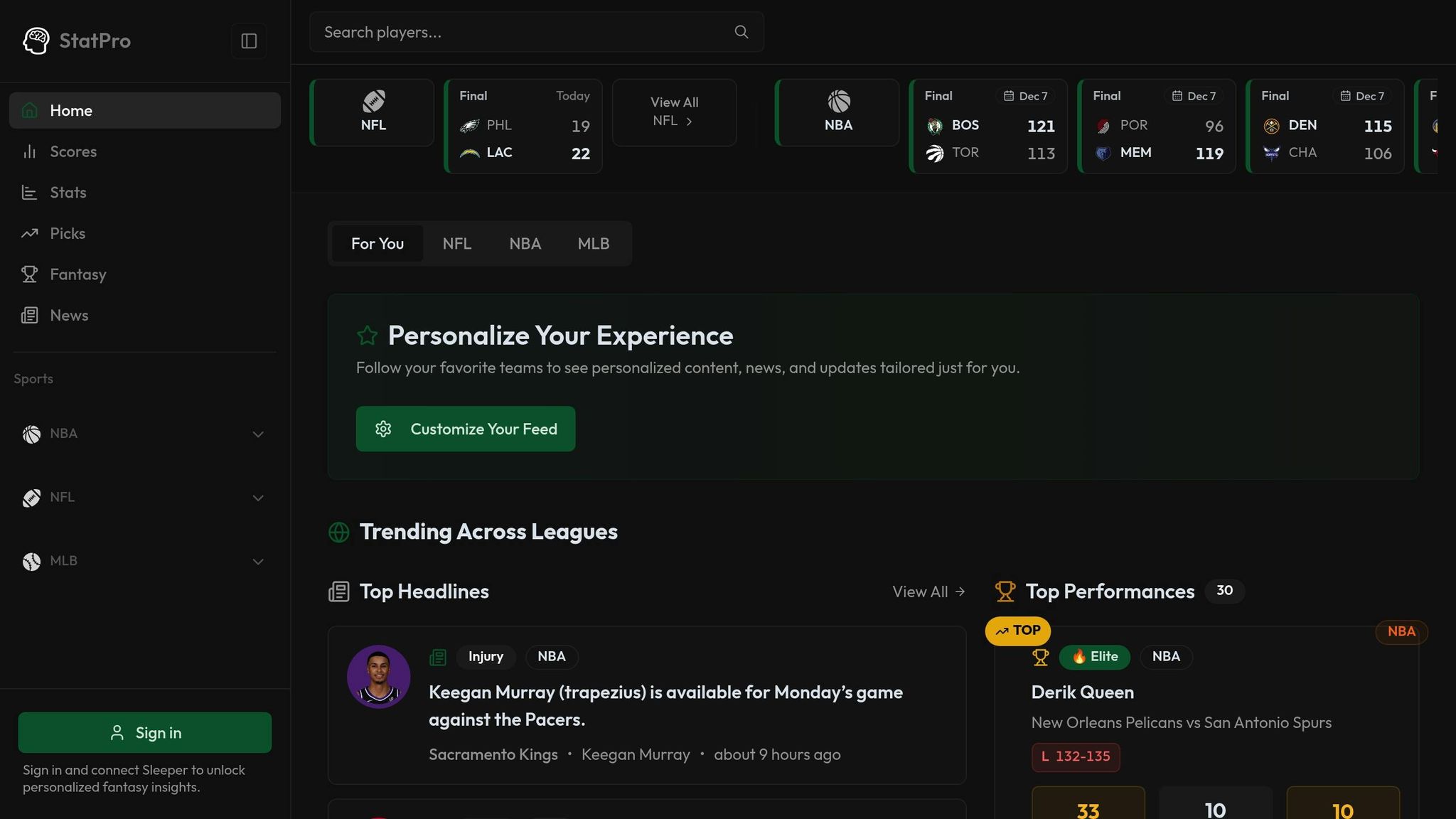
Bringing these unified data streams to life requires robust, real-time platforms. StatPro, for example, provides continuous sports analytics and injury updates for leagues like the NFL, NBA, and MLB - exactly the kind of infrastructure needed for future concussion ML systems.
When paired with ML models, platforms like StatPro can create closed-loop systems where predictions lead to immediate interventions, and outcomes feed back into the models for continuous improvement. If an ML system flags a player as high-risk due to subtle performance declines or changes in movement patterns, the platform can alert medical and coaching staff in real time. This enables timely adjustments to training intensity, playing time, or rehabilitation plans - potentially preventing secondary injuries before they occur.
Continuous monitoring is especially valuable since secondary injury risks often extend beyond the initial recovery period. Rather than relying on one-time assessments, these platforms enable ongoing health surveillance. For example, StatPro can track a player’s performance metrics against pre-injury baselines, flagging deviations that might indicate lingering issues. This aligns with findings from the University of Delaware, which showed that tracking individual deviations from baseline is more predictive than static measurements.
Workload data is another critical piece. By monitoring practice participation, play counts, and intensity levels alongside ML risk scores, teams can make informed decisions about limiting exposure or modifying training loads. If a returning athlete shows elevated risk scores, coaches can adjust their strategies to prioritize recovery.
For research, platforms that aggregate data across teams and seasons provide the large, standardized datasets ML models need for validation. A study analyzing 971 college athletes using data from the CARE Consortium and FITBIR database demonstrated the value of shared data infrastructure. Similar efforts in professional sports could improve model development and validation across diverse populations.
The ultimate goal is seamless integration between wearable sensors, clinical assessments, game statistics, and ML engines. When these systems work together, teams can shift from reactive injury management to proactive safety programs, addressing risks before they escalate into injuries.
Conclusion
Machine learning is transforming the way sports medicine teams handle concussion prediction and player safety. Current models are capable of forecasting recovery timelines, identifying athletes at risk for prolonged recovery, and predicting lower-extremity musculoskeletal injuries. These models, which analyze factors like cognitive performance, movement patterns, and symptom data collected within 24–48 hours after an injury, have shown accuracy rates between 85% and 95% in studies . This progress is paving the way for new strategies in concussion care.
With these tools, athletic trainers can pinpoint high-risk athletes early and design targeted interventions, while coaches can make informed decisions about training intensity and playing time based on objective risk scores. Research also highlights that injury risks can linger for weeks or even months as athletes unconsciously compensate for subtle deficits, making extended monitoring after initial clearance crucial.
Looking ahead, future machine learning systems are expected to integrate data from wearable sensors, balance metrics, and neuroimaging into unified platforms. Explainable AI will allow clinicians to understand which factors, such as balance issues or symptom severity, are driving each risk assessment. Platforms like StatPro, which already deliver detailed sports analytics and real-time performance data for leagues like the NFL, NBA, and MLB, are well-suited to support these advancements by providing the workload and exposure data needed to refine concussion models.
However, there are still challenges to address. Even the most advanced models can only partially explain recovery outcomes, and many have been validated primarily on college athletes, pointing to the need for broader testing across youth sports, women’s leagues, and more diverse populations. Integrating these tools into clinical workflows, electronic health records, and sideline protocols will require significant time, technical resources, and adherence to strict privacy standards. Most importantly, machine learning tools are designed to complement - not replace - clinical expertise and established concussion protocols .
The evidence suggests that when combined with medical expertise, machine learning has the potential to improve concussion prediction and promote athlete safety. By merging data-driven insights with clinical judgment, sports medicine can take a significant step toward a safer future for athletes.
FAQs
How is machine learning enhancing the accuracy of predicting concussion recovery in sports?
Machine learning is reshaping the way we predict concussion recovery by processing massive datasets with speed and precision that traditional methods simply can't match. By spotting trends in player health metrics, game statistics, and recovery timelines, these models can deliver more tailored and accurate recovery forecasts for athletes.
These algorithms dive deep into details like concussion severity, an athlete's medical history, and real-time health data. The result? Insights that were once out of reach. This allows medical professionals and sports teams to craft safer, more effective recovery strategies, giving athletes the care they need to get back in the game responsibly.
What ethical considerations come with using machine learning to predict sports-related concussions?
The integration of machine learning to predict sports-related concussions brings up several ethical challenges that can't be ignored. One of the biggest concerns is privacy. To make accurate predictions, sensitive health data from players must be collected, stored, and analyzed. This process demands robust safeguards to ensure the data isn’t misused or accessed without proper authorization.
Another pressing issue is bias in algorithms. If the data used to train these models is incomplete or skewed, the predictions could be unreliable or unfair. This might not only impact the accuracy of the results but could also have serious consequences for players’ careers and health.
Consent is also a critical factor. Players need to be fully informed about how their data will be used and should have the option to decline participation without facing pressure. Finally, the accuracy and reliability of these machine learning models cannot be overstated. Without thorough validation, relying on these predictions could lead to poor decisions regarding player safety.
Addressing these concerns is crucial to ensure that machine learning tools are used responsibly and effectively in the world of sports.
How do wearable sensors and data sources improve machine learning models for concussion prediction and care?
Wearable sensors, including accelerometers and gyroscopes, capture real-time details about impacts, head movements, and forces experienced during sports. When combined with additional information - like medical history or game stats - this data becomes a powerful resource for machine learning models to pinpoint patterns associated with concussions.
By processing this extensive dataset, machine learning can estimate concussion risks, aid in early detection, and guide tailored recovery plans. These technologies play a key role in creating safer sports environments and enhancing how concussions are managed.